
More History Means More Places for a Leak to Start
A correctly functioning AC system does not consume refrigerant the way an engine burns through oil. It stays sealed inside a closed loop of copper for the entire time the equipment is in service, and the charge it started with is the charge it should still have years later. So when a technician says your system needs more refrigerant, that statement really means there is a leak somewhere in the loop, and the location of that leak often has everything to do with how many times the line set has been touched since it was first installed. A system installed once, during original construction, and never modified has far fewer opportunities for a leak than a system whose line set has been extended to reach an addition, rerouted around a remodel, or spliced when the outdoor unit got moved or replaced.
This explains why age and retrofit history matter so much for refrigerant leaks specifically, and what that means for homes across Studio City, Sherman Oaks, and the rest of our service area.
What Refrigerant Actually Does, and Why the Loop Has to Stay Closed
Inside the home, refrigerant picks up heat at the evaporator coil. That same refrigerant, now carrying the heat pulled from your living space, travels outdoors through the copper line set and gives that heat up at the condenser coil before circling back to do it again. The whole path is meant to be a single unbroken loop, changing between gas and liquid as pressure shifts along the way, so it can keep making that trip indefinitely without losing any of its charge. Every joint along that path, every fitting, every brazed connection, every place a line was ever cut and rejoined, is a potential point of failure. A system with a longer, more complicated history simply has more of those points than one that has run untouched since installation.
Why Retrofit Line Sets Accumulate More Failure Points
When a condenser gets relocated during a remodel, or a line set gets extended to serve a newly added room, someone has to cut into the existing copper and create a new connection. Each of those connections is done well or done poorly depending on who did the work and under what conditions, but even a well-made joint is inherently more vulnerable than continuous, unbroken line. Over years, vibration, thermal expansion and contraction through repeated summer and winter cycles, and simple age work on every one of those joints. A home where the system has been modified two or three times over its life is carrying two or three times the risk at these connection points compared to a system nobody has ever touched.
Why Hillside Lots Add Vibration to the Equation
Condensers on hillside properties, particularly ones installed on pads that were never properly leveled during a retrofit install, develop line vibration over time as the pad settles unevenly. That ongoing vibration works on fittings and connections the same way constant flexing works on any metal joint, slowly wearing through a connection point that started out sound. This shows up more often on older hillside lots off Fryman Canyon, where the condenser pad was frequently an afterthought added to whatever side yard space was available, rather than engineered as part of the original site plan.
The Signs, Read Through the Lens of System History
Warm Air From the Vents
The most obvious sign, and one that develops gradually over a season when the leak is small, which is common at an aging fitting rather than a fresh puncture.
Ice on the Lines or Indoor Coil
Low charge causes the evaporator coil to run too cold and freeze condensation on its surface, sometimes visible on the copper suction line outside even during a 95 degree afternoon.
A Hissing Sound Near a Fitting
More common with a larger leak at a specific connection point, which lines up with the retrofit history explanation: a joint that was added later is a more likely source of an audible leak than continuous factory line.
Rising Bills Without a Clear Cause
A system low on charge runs longer to deliver the same cooling, showing up as a gradual climb in your DWP bill separate from expected seasonal usage.
Oily Residue at a Fitting
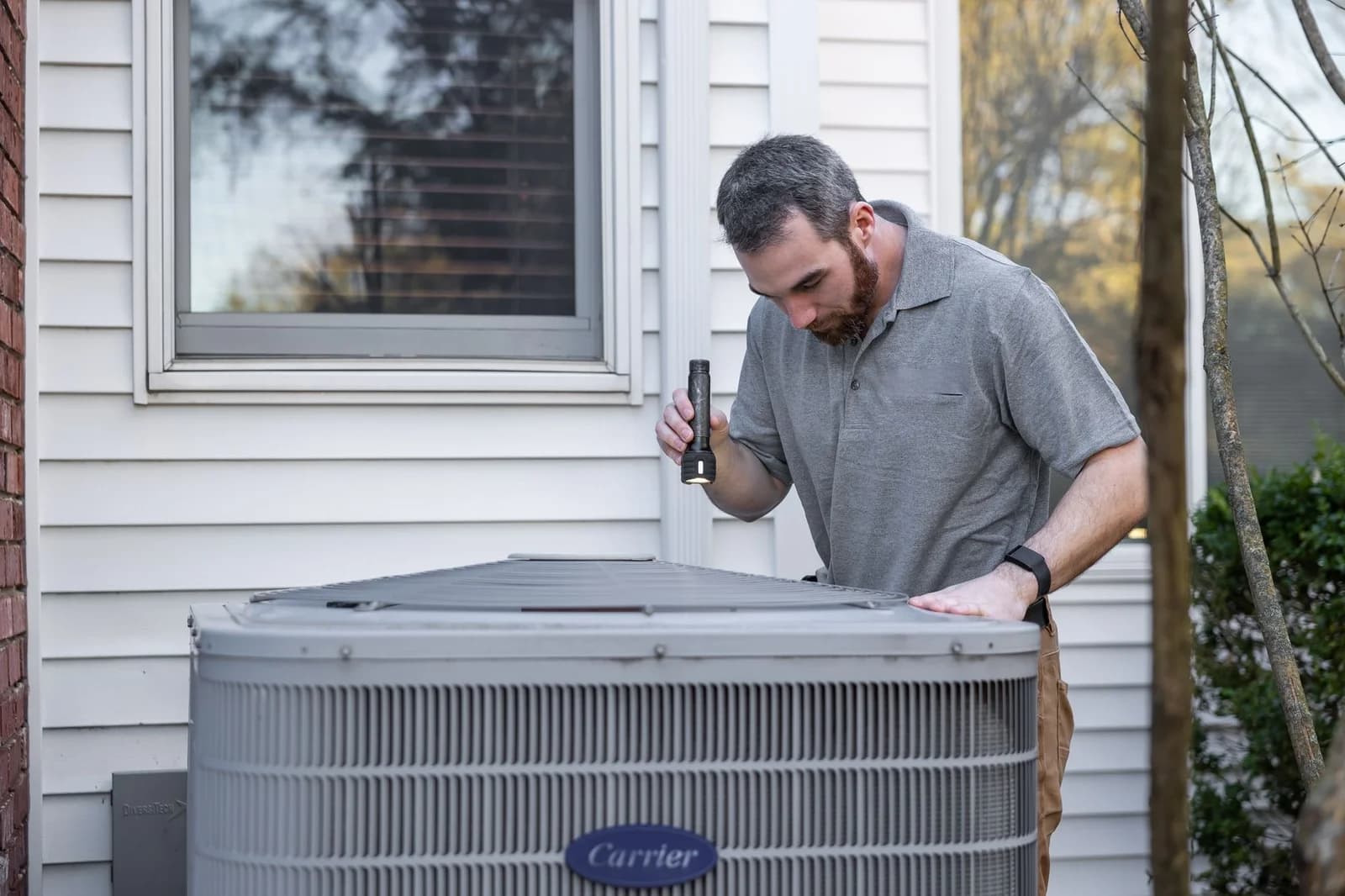
Refrigerant leaks carry a small amount of lubricating oil with them, and a technician checking your system looks for that residue specifically at valve stems, flare fittings, and any joint where a connection was ever made, which is exactly why we ask about a system's installation and modification history before we start looking.
Why This Matters Beyond Comfort
The oil that circulates alongside refrigerant is what keeps the compressor's internal moving parts lubricated and properly cooled while it works. Once charge drops too low, that lubrication thins out along with it, and the compressor starts wearing on itself with every cycle it runs short on fluid. Weeks or months of operating that way is a well-documented path to a premature compressor failure, and because compressor replacement carries such a steep labor and parts cost, homeowners in that situation often end up weighing it against putting the money toward a full system instead. Refrigerant handling is also federally regulated, and technicians must hold EPA Section 608 certification to legally purchase, handle, and recover it, which is part of why finding and repairing the actual leak, rather than simply adding more refrigerant, is the standard the industry follows.
A Note on Retail Refrigerant and Retrofit Systems
Retail cans of refrigerant marketed for do-it-yourself top-offs are already restricted by federal law for most residential systems, and they are a particularly poor fit for an older system with retrofit history. Adding refrigerant without finding the leak first just delays the same problem, and on a system with multiple splice points from years of modifications, guessing at which connection is losing charge instead of testing for it can mean adding refrigerant that never reaches the actual leak in any useful way. If a system needs refrigerant, finding the leak has to come first, and that is truer the more times a system's line set has been touched over its life.
Why We Ask About History Before We Ask About Symptoms
Two systems can show the identical symptom, warm air, ice on the lines, a rising bill, for completely different reasons depending on how many times each one has been modified. Asking about a system's installation and remodel history up front, before running a single test, narrows down where we look first and usually gets us to the actual leak faster than starting from scratch on every visit as though the system had no history at all.
How We Trace a Leak With System History in Mind
We start by asking how the system has been modified over its life, since that history points us toward the connection points most likely to be the source. From there we check pressures against manufacturer specifications and use electronic leak detection, and where needed a UV dye method, to confirm the exact location rather than guessing. Leaks at accessible fittings and connection points are typically repairable. A leak inside the coil itself sometimes calls for coil replacement depending on its age and condition.
Preventing the Next Leak in a System With History
Annual maintenance that includes a refrigerant pressure check catches a developing leak early, before months of low charge have already strained the compressor. If your condenser sits on a hillside pad, confirming it is properly leveled and secured reduces the vibration that wears on fittings over time. And any time a line set has been extended or rerouted for a remodel or addition, that work deserves the same care as an original installation, not a shortcut because the rest of the system is already in place.
Schedule a Refrigerant System Check
If your AC isn't cooling the way it used to, especially in a system that has been modified, extended, or relocated at any point, we look at your system's actual history, not just today's symptoms, to find the leak and fix it correctly. That approach is why homeowners across Studio City, Sherman Oaks, Toluca Lake, and Valley Village keep calling Studio AC Co. back for follow-up service. Dial (877) 704-7652 for a diagnostic.
Need Professional HVAC Service?
Our HVAC-experienced technicians are ready to help with all your AC and heating needs. Contact Studio AC Co. today for expert service throughout the Sherman Oaks, Toluca Lake, and Valley Village service area.